The Weight of the Years: A Story of Highs, Lows, and Cautious Optimism
A Note Before We Begin: This post dives into sensitive territory, including discussions on weight loss, emotional abuse, body image, and women’s reproductive health. Please read with care and prioritize your own well-being.
In the modern era, we’re told that almost any problem can be solved with the click of a button or a quick scroll through an app. But some things don’t have an "instant fix." Some things take a lifetime of unlearning, relearning, and navigating.
I’ve always considered myself a cautious optimist—someone who looks for the silver lining while keeping their feet firmly on the ground. Yet, there is one area of my life where that optimism has been tested for decades: my relationship with my weight. Today, I want to pull back the curtain and talk about the role weight has played in my life—the good, the bad, and the undeniably ugly.
The Girl Before the "Numbers"
Believe it or not, I entered the world already making a statement. I was a ten-pound, 22-inch newborn. I joke that I’ve never been in the "single-digit" weight category in my entire life.
Looking back at old photos, I see a relatively "normal" sized kid until about age six or seven. That’s when my face began to round and my belly grew. But the thing is? That little girl didn't know she was "bigger." She was just existing. I look back at her now and feel nothing but a fierce, protective love. While the adult version of me wishes I’d been guided toward healthier choices, I would never wish the torment of body-checking on a child that young. She deserved to just be.
The Amazon in a Y2K World
Everything changed in the "tween" years. While other girls were waiting for their growth spurts, I had already arrived. By age ten, I was 5’9”—towering over the average American woman before I’d even finished elementary school.
I remember a specific afternoon in fifth grade. A group of girls were chatting about their weight, and I piped up with total, naive confidence: "Oh, I’m probably 150 pounds." The silence that followed was deafening. Looking back, I realize they were either shocked by a number that seemed massive to a ten-year-old, or they knew just by looking at me that I was actually much heavier. Not long after, I left a doctor’s office in tears after the scale read 203.
It was the era of Y2K fashion: low-rise jeans, blonde hair, and petite, waif-like frames. I was a curly-haired, brunette, curvaceous, Amazonian woman. I wasn't just "big"—I felt like I was playing a game where the rules were written for a completely different species.
The Point System and the Oreo Solace
At thirteen, my mom and I joined Weight Watchers. It was the late 2000s—the era of tracking everything in little paper pamphlets. I remember eating everything with mustard because it was "zero points."
But the weight wasn't just about food; it was about feelings. My mother and I were emotional eaters, and for good reason. As I’ve shared before, my father was emotionally abusive toward my mother. Even though I wasn’t the primary target, I lived in the blast radius. I can still vividly recall the two of us sitting together, binging on a pack of Oreos, feeling that fleeting, sugar-coated relief from the tension in the house. Food wasn't just fuel; it was a shield.
The High of the Decline
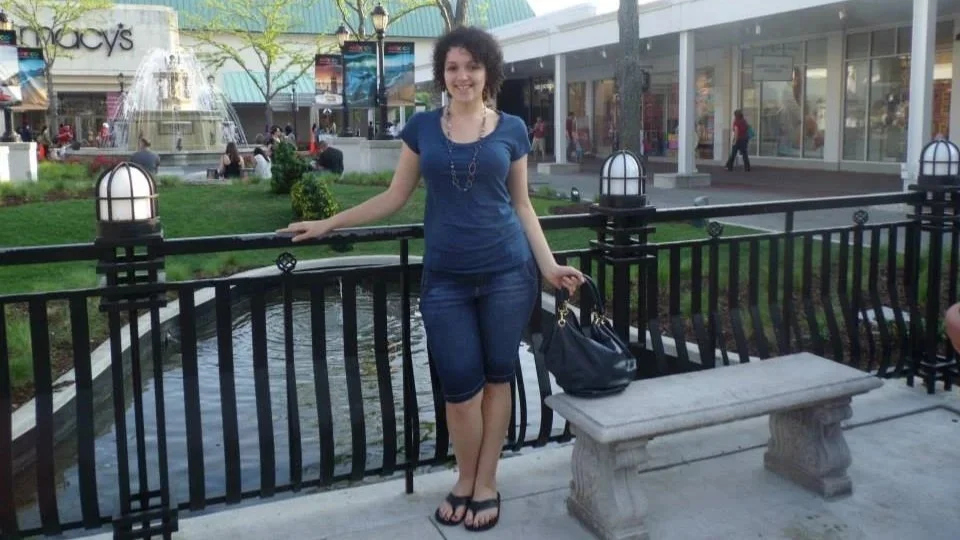
By my late teens and early college years, I had lost 80 pounds. At 193 pounds, I was officially lighter than I had been in the fifth grade. I felt like I had finally "arrived."
Suddenly, the world looked at me differently. I received external validation from family, friends, and men. I felt like I finally fit into the story I was supposed to be telling. But beneath the surface, the "cautious optimist" was becoming a perfectionist. I was losing muscle along with the fat, my arms were losing their definition, and despite being "thin" by my standards, I still saw that same "chunky" girl in the mirror. My self-worth had become entirely tethered to a number—a dangerous place for anyone to live.
The Diagnosis
Then came my twenties. Slowly, despite my best efforts, the weight began to creep back.
I had struggled with irregular cycles my entire life, usually being shuffled onto "the pill" as a catch-all solution. But as the scale climbed, the panic set in. Calorie counting didn't work. Exercise didn't work. Eventually, a series of blood tests and an ultrasound provided an answer: PCOS (Polycystic Ovary Syndrome). For those who don't know, PCOS is a hormonal imbalance that can cause insulin resistance, making weight gain easy and weight loss feel nearly impossible. Getting that diagnosis was a trauma in itself. I cycled through fad diets—from high-carb veganism to extreme restriction—oscillating between "I’m going to fix this" and "What is even the point?"
Where I Stand Today

That brings us to the present. To be completely honest, I am currently at my heaviest weight. It is exhausting. It’s hard to watch your clothing sizes go up and feel powerless to stop it.
However, there is a paradox here. While I am at my heaviest, I am also at my strongest. I can leg press 700 pounds. I can bench over 100. I am a powerhouse, and I am learning to be grateful for a body that still moves, still walks, and still carries me through the world.
I still struggle. I still bounce between intuitive eating and the urge to count every leaf of spinach. I still desperately want to be smaller, even as I work to be stronger.
No Pretty Bows
I wish I could end this post with a perfect "Life Lesson" wrapped in a bow. But life is messier than that.
I wrote this because I needed to get these thoughts out of my head, and because I know some of you are walking this same tightrope. In a few days, I’m meeting with a nutritionist from Nourish. I’m going back to my roots: I’m being a cautious optimist. I’m not giving up on myself. I’m just looking for a new way to move forward—one that values my mind as much as my body.